
Hall & Gilbert Gang vs The Faithfulls
A shootout between
The Ben Hall & John Gilbert Gang and four brothers from the Faithfull family on 6th February 1865.
This file viewing has been produced on 29th September, 2025.
There are multiple videos embedded in this webpage, make sure you work all the way down to the bottom of the page and watch each clip and you move through the information Malcolm has thoroughly researched and provided on this fascinating moment in Australia’s bushranger history.
Introduction
Don’t think this is going to be easy, I have put it together to expose my line for research with input from others, to let the reader form their own opinion from what has taken over six months concentrated research. Comments are identified by my initials ‘MD’, after some correspondence. These are not always my comments but statements made in passing by those who have also reviewed this material and been constant reference sources.
An English teacher once said, ‘as long as you get your message across then its English’. Powerful and very applicable words for me to follow, so you will have to forgive me if I make mistakes as my aim is to get the message across. Spoiler alert, humans do make mistakes but we are humans studying humans and so from one human to another we have now a riddle to unravel.
We offer the reader a chance to follow our line of enquiry, our line of reasoning and the outcomes that arose from our angle. It would have been so simple to pick up a book and then see the sources and verify the story, all finished all done. There are more version of this than Aunt Mary’s Christmas pudding with extra sherry and rum added for spice.
The story involves many interested parties who have all had a great input towards my attempt to unravel many concepts becoming busier than a nuclear fusion reactor chamber.
Forgive me if some things are repeated or in the wrong order as this project has raddled my brain and I have given it enough of my time. I am human and make mistakes as do others but that said, I have involved others to help keep me on track. It is not just my research, but an information database put together with the help of people renowned for their commitment to Australian history correctness. The aim here is to put in one spot as much information as possible (not all but enough) I have tried to keep unbiased and when formulating a hypothesis I will say it’s my view. This file has been segmented into subjects; Family letters, Newspapers, published book and most important research.
Simple enough this project started as a side shoot, a story of interest to complement the Firearms doco as most of my black powder firearms experts all had an interest in bushrangers, police and the weapons they carried. I thought it would add some content to profile one of these talked about events. My original source for the story came from Edgar Penzig’s book on Ben Hall and then debate followed with many other accounts coming to light. It is not for me to judge this complex subject but to prove a path for enlightenment. In doing so I hope to present an overview that helps access how and why things happened. I apologise for in some cases repeating statements used in ‘Chapter 7’ and the ‘Extras’ (chapter 8), as I want the story to flow, to remind the reader of all that has transpired. Starting with an overview before we get down to newspapers books and associated correspondence.
Bad to the bone. Bushranger profile
The actions of villains are often driven by selfish desires, such as power, wealth, or revenge. What makes a bushranger tick, today or yesterday they are the con merchants, thieves or those born to kill.
Scholars state our DNA has hard wired us to trust. We think we are good lie detectors but are not; that’s why we continually get conned, scammed or murdered.
Problem is we are not all exactly the same.
A while back there was a survey done involving army infantry finding 96% of soldiers did not shoot to kill while 96% of the killing was done by 4%. Transfer this to the wider population and there’s your percentage for bad verses good. Just because a person has a nasty streak doesn’t mean their stupid. Hall and associates were in the game for a few years before they had encountered the Faithfull’s. Keeping one step ahead they groomed and intimidated their way through life. Yesterday’s newspapers reported people on the take who would notify them of easy targets or police. Kids were used on road intersections as harmless lookouts. A lot of their loot went to paying for their safety while some was profit. Refer Sydney Morning Herald 1st March 1865 where the article focused on how bad and cunning bushrangers were, with just a tad on the Faithfull’s event.
All bushrangers paid harbourers and lookouts, Harry Power who tutored Ned Kelly often complained about how much his ‘supporters’ cost. Criminals are in it for the money, police knew this support was purchased, that’s why they offered more in reward money.
Gunfights
A documentary about firearms predictably involves fights between goodies and baddies.
One of the world’s most famous gunfights was in America at the Ok Coral year 1881. About 30 seconds to fire about 30 shots by five against four men, standing 3 to 4 yards apart.
Three Earp brothers and Doc Holliday were known to carry shotguns and Army revolvers, ironically known as “Peacemakers”. While five on the other side armed with revolvers consisted of the Clanton and McLaury brothers.
Fictionalized accounts have popularized this shootout at the OK Corral, while the historical record is complex and not always clear.
The same contradiction of events is also true for one of Australia’s most interesting gunfights. The shootout between three of the Ben Hall gang and four brothers from the Faithfull family near Goulburn year 1865. Around 100 shots exchanged over a few minutes in a roadside robbery gone wrong. Most important, a shootout did take place and credit should be given to the Faithfull’s for challenging the bushrangers. The facts mustn’t be clouded by too much speculation and ambiguity, a difficult balancing act when some evidence is missing and the story seemed to grow over time.
Research
Many publications varied while some sourced previous authors. Newspapers and later correspondence by family members added to the mix.
There was continual contact with:
- State Archives,
- State Library,
- National Library,
- National Museum,
- Royal Australian Historical Society,
- Goulburn Historical Society,
- Goulburn Photography Club,
- Goulburn Visitor information Centre,
- Eugowra historical society,
- onsite inspection.
Plus, a multitude of emails and phone conversations with numerous antique firearms experts and interested parties. An intense 6-month general debate as new bits came to light.
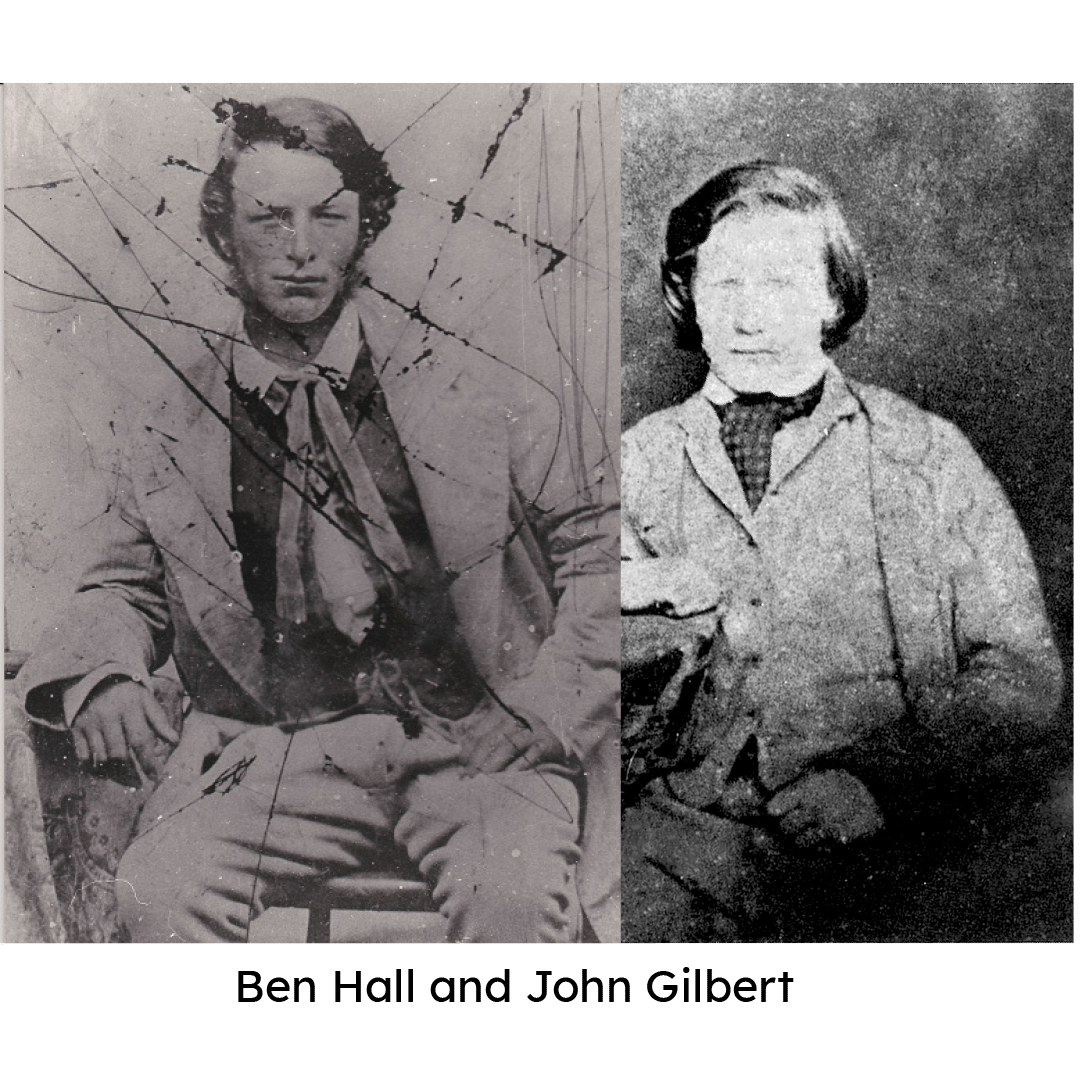
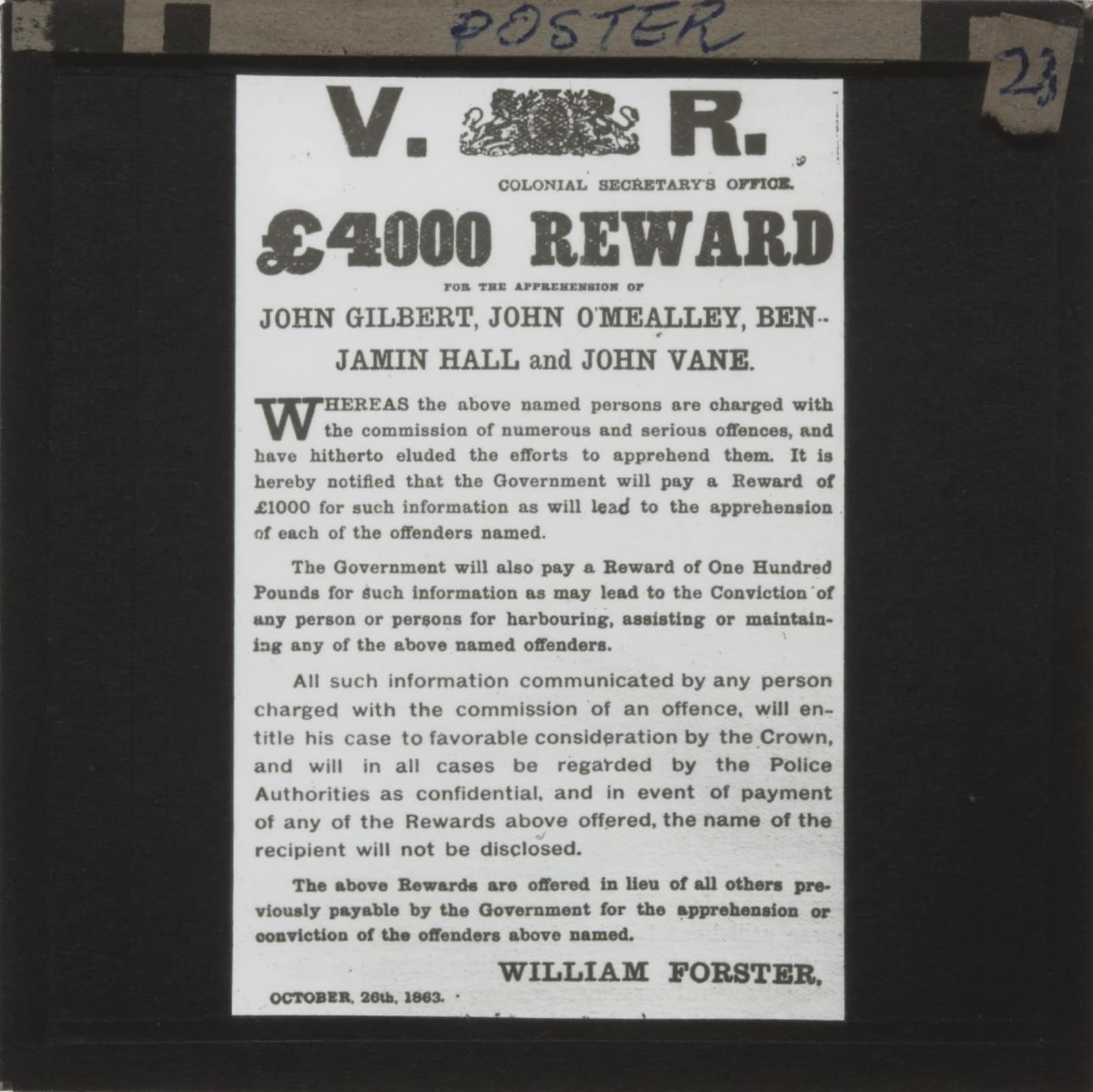
Original Reward Poster for the Gilbert & Hall Gang

Original depiction of the shootout where John Gilbert perished

Edgar Penzig’s book on Ben Hall
As it is written. Overview of publications
People often quote from books without knowing has Chinese Whispers been part of the narrative or, is that writer a 4%er, a reliable historical source. Or do I have practical experience in this subject and does it make sense? From the family involved we have three main informants, whom if their word or repeated words are to be compared, they are not always compatible. These statements come from the father, William Pitt Faithfull and his two eldest sons William Percy and George Ernest. I have no idea as to their ability to recall accurately or to manufacture a story. In Stephen Fords (experienced researcher) words, ‘This exercise has more twists than a corkscrew’. One of his first comments (as were my thoughts) was the reason why he became involved, ‘this doesn’t make sense’.
Some documents were recorded to exist by official agencies but were missing and had been re-typed out for publication rather than using the original document which would suggest doctoring of script to suit a slanted story. With the original missing in action its hard to say especially when the same author covered the story a in a second publication but omitted this document.
The following is an attempt to differentiate between fact and conjecture by recognised historian or newspaper journalist.
The Faithful’s shootout has attracted many a writer. Edgar Penzig’s book ‘Ben Hall the definitive illustrated history’ is regarded as the bible for correctness and exhaustive research so it was the starting point.
Edgar stated that George was firing at Gilbert ‘with cool deliberation’. The only words I found that matched were from Sydney Morning Herald 1st March 1865 when the journalist said in reference to all four boys … ‘Their cool deliberation’. I could see where he found the phrase but not in the context used in his story.
With no independent witness records, no police report and the villains dead a few months later it’s difficult to put together the exact story. Edgar writes with conviction like he was there. Edgar was a theatrical actor, playwright, song and poem writer, he was keen but not happy to accept the work of others if it didn’t fit his view.
This does not mean Edgar was wrong, his enthusiasm and commitment combined with writers’ licence to dramatize the whole event might be right. I have no idea where he got most of the details, they don’t make sense, but a lot of history doesn’t make sense. It is what it is, Edgar’s very debatable descriptive story that I cannot corroborate and that’s history now. I found no records to back up his statements saying; this person aimed but for an unknown reason did not fire or, they both looked each other in the eye or, they scrambled over the fence. Or The youth was having some trouble finding his percussion caps and in the rush of loading the ramrod was sticking in the barrel. Or George Ernest was firing at Gilbert with cool deliberation, expecting to see the villain fall off his horse with each shot.
Edgar describes Regie and Monty holding the horses while bushrangers gallop towards them in a hail of bullets while Percy and George take cover behind the carriage returning fire. More believable, Kevin Passey, says the boys crouched in the carriage and then hid behind it, no mention of holding the horses in his book “Lachlan Landmarks”.
The eldest boy Percy, ten years after the event trying to give some credit for bravery wrote to say his younger brothers held the horses until one horse was shot in the thigh and they broke away, but strangely nothing penned by Regie or Monty could be found.
The most believable story was published by The Yass Courier, Saturday, February 11, 1865.
This narrative five days after the incident states ‘one of the bushrangers galloped alongside the break, shouted ‘look out,’ immediately fired a blank shot, and passed on. The other two bushrangers were then distant about 100 yards, and also commenced firing…. they at once returned fire.
The journalist hesitates to say what he does not know. Proving his knowledge he details the names of the stolen racehorses the Hall gang were riding.
Eighty four years later, Smiths weekly magazine writes…Then Ben got a shock as Percy Faithfull fired a warning shot at him from the careering drag with the Kerr rifle. Gilbert and Dunn immediately galloped into the fray, firing their revolvers.
They rode “flash,” with the reins tied to their knees, leaving their hands free for holding two revolvers.


The Yass Courier Article

Well John Wayne’s True Grit movie had to get inspiration from somewhere? On that Subject hearsay inferred John Gilbert was a trick rider and totally unrelated a lady bushranger from Rylstone (NSW) named Elizebeth Hickman was circus rider and often eluded police with her daring acrobatic riding skills. It is not unreasonable to believe that Gilbert and Dunn rode ‘flash’. I can speak from experience. A good horse trained in bush skills can easily be steered with your knees and learns to move in balance with your seat. Too much to explain here.
Revision
To refresh, Ben Hall, John Gilbert and Jonnie Dunn on 6th February 1865 attempted to stop four brothers 10 miles out of Goulburn on the Braidwood Road as they left their parents property ‘Springfield’. The siblings were 14-year-old Reggie unarmed, 16-year-old Monty unarmed, 18-year-old George armed with a pocket colt and the eldest was 20-year-old William Percival Faithfull wearing a volunteer military coat and carrying an 1862 Kerr’s target rifle, The father was William Pitt Faithfull and for that reason his eldest son is often referred to as Percy.

George’s Pocket Colt
It’s about a mile to the front gate and they head towards Goulburn driving a four in hand break. About 400 yards down the track Hall’s gang have stopped two mail coaches robbing mail bags and are holding hostage their fathers bullock wagon and driver with two men and a girl on horseback. According to Passey the bushrangers were near the main gate of Springfield station about 10 miles from Goulbourn, the house was ¾ of a mile to the gate. The vehicle came out of the gate and travelled about ¼ of a mile when attacked. Of interest he notes an employee of the Faithfulls was stopped earlier with his bullock team, no name mentioned but he claims 2 coaches stopped and allowed to proceed, one driven by Owen Malone, the other by “Brumby” Richards.
Typically, the Hall gang carries no rifles, they each habitually carry six revolvers which would account for the large volume of shots fired. One report says Hall had seven revolvers on him most of the time.
Upon seeing the boys the gang fires the first shots to intimidate them into stopping. They fight back. Percy has six pre prepared shots for his rifle and George has some balls with a little powder for his revolver. This might mean he has low loads although Edgar Penzig is the only reference I could find that uses the phrase ‘low loads’.

The Faithfull brothers involved in the bushranger incident, about 1865 (from left) Reginald, Percy, Monty and George. Springfield–Faithfull family collection, National Museum of Australia

Kerr’s 1862 target rifle the type carried by Percy Faithful
The boys make it back safely home to live happily ever after; the bushrangers rat the carriage for very little leaving to fight another day.
The thrust of the story is the Faithfull’s did have a shootout with Ben Hall’s gang, but like witnesses to a car accident there are many different versions and police reports from that area do not go back to 1865.
There are letters from William Pitt, and the two eldest children. Some sightings from 12 year old Florence the sister and the 6th in line brother also wrote his account.
Family Letters


Possible scenario
The family homestead is more like a mansion out of ‘Gone with the Wind’. This is very well-off family, a racecourse, a church, like a mini town, the flour mill and the stables are more like large factory building rather than farm buildings, so hostages for ransom cannot be dismissed however from a high-profile family this could have attracted an unwanted full-scale response, most likely it’s a petty roadside robbery that went wrong as the Hall Gang had been doing that for days prior.
Letters and newspaper articles say the boys were not expecting to encounter bushrangers, but I find that hard to believe it wasn’t considered as a possibility as the bushrangers had been operating in the area for days. After all Percy was wearing a military uniform and caring a military target rifle and six cartridges supposedly to shoot eaglehawks or scrub turkeys on the way home after dropping the two younger brothers off at Goulburn for their coach trip back to the Kings School at Parramatta. Not sure why he would want to shoot scrub turkeys with a Kerrs target rifle. Even at 500 yards a hit from that rifle would just leave a puff of feathers. Eagles possibly and I will cover that in a later YouTube clip but poisoning with strychnine or an Eagle trap was more the way to go.
Normal practice is once out the front gate you close it inadvertently blocking any retreat.
From here things turn sour as one shot fired by bushrangers started the event and the boys didn’t stop but instead sped up and returned fire. My thoughts are they try to circle back to the main gate pulling up quickly on the home side of the road using the break as cover until the horse’s bolt a minute later. By then Dunn has exhausted his six revolvers 36 rounds and had to ride back to make sure his captives stay put. Gilberts a better horseman and so he takes the offensive but as his horse rears he shoots in the back of the head leaving him on foot. Hall has a limp resulting from a horse accident when he was younger that broke his leg. This will affect his horsemanship and mobility that’s probably why Hall is not so proactive at this point.

The Revolver supposedly dropped by Hall gang

Revolver tagged as dropped by the Hall gang
Supposedly Gilbert has lost his stolen police issue 1851 Naval colt revolver that did his horse in, he gathers himself targeting the kids. By now they are at least 100 yards down the fence line heading either toward the main gateway or up a slight incline towards the cover of some trees as Gilbert’s shoots at Percy. Too far for the revolver but not for Percy’s Kerr’s rifle. Gilbert takes cover behind a post or is near it; Percy fires and hits the post. Gilbert quickly retreats with Dunn coming to the rescue to double him back to the second gate where the bullock wagon and others are. Earlier while the break was used for cover George reportedly fired four shots. Percy has used 5 and has only one shot left which would be easily enough to take Hall out at distance while Hall can only lob a few short range projectiles in the direction of Percy. I don’t think Hall ever jump the fence in pursuit on a stolen racehorse. Post and rail would be daunting for a trained jumper!
Racers weren’t jumpers and I don’t think Halls leg injury allowed for any real trick riding. Plus, Hall would have no idea exactly how the boys were armed.
Age 12 Florence Faithfull the younger sister remembers hearing shots and seeing the smoke from the front verandah of the homestead. I think she would have alerted farm workers. No way Hall would have ridden to within 100 yads of the house. One story I have found has people from the house providing fire power cover for the boys to get home. Although later the father said there was a strong westerly wind blowing which would have dampened the noise and quelled the smoke. Florence lived into her 90s.
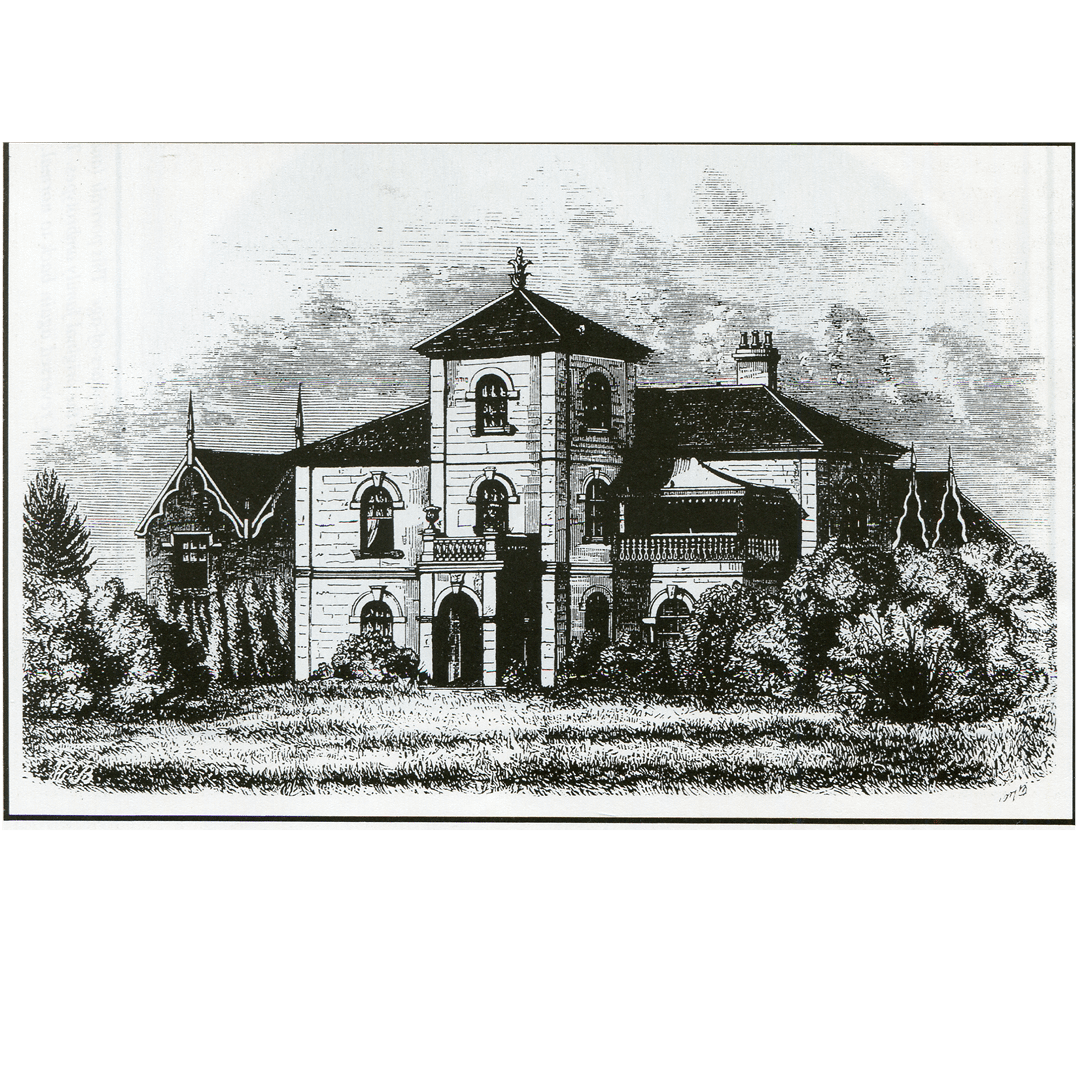
Springfield Homestead

Percy Faithful – about 20yrs old
Meanwhile back at the homestead the boys recorded re-arming themselves to go back out to confront the bushrangers. Although another report states a posse was formed to take on the gang. As time allows by then the bushrangers had left having ransacked the break. I feel in bitter discontent using the break as target practice riddled it with bullets marks. Just like car thieves setting fire to a car after they steal it, this would also explain why no one was hit with any bullets.
According to Kevin Passey “Lachlan Landmarks” the boys were travelling to Goulburn, about a 10-mile trip. He notes that the original post that was shot by William was removed due to vandalism but the homestead was still standing (1986). He also notes: “Up until the 1930’s the four-in -hand brake which the Faithfull boys were travelling in, was still in existence with reputed bullet marks from the encounter with the bushrangers”. I found no mention of this encounter in other books by Boxall and White.
Except for Percy’s letter stating that his younger brothers held the horses until they broke away after being wounded. Kevin Passey, says the boys crouched in the carriage and then hid behind it, no mention of holding the horses. His book “Lachlan Landmarks” gives directions to the scene of the shootout and there was a descriptive notice placed on the spot (in 1986) but now probably destroyed by the usual louts. In Frank Clune’s book “The Wild Colonial Boys”, Clune covers this incident as a “bit of a lark”.
Having used most of their ammunition and not wanting another confrontation with possible workers and father, Hall and gang exit stage left. I think they would have been rattled that kids had stood up to them and got away.

Kevin Passey’s book Lachlan Landmarks
After the event
10 years later the Faithfull’s applied for a medal, receiving it the following year after their version of the story was reviewed. Having faced these notorious bushrangers, it defies logic why they were still alive especially if you read their account. George recalled looking down the barrel of Hall’s pistol so he could see up the barrel in retaliation striking at Hall with his buggy whip. What’s the saying don’t take a knife to a gunfight. Although George did have a revolver in his pocket. Easy to say; could have would have should have. Reacting under pressure can produce strange outcomes.
Sticking to the facts a shootout did exist. Heaps of shots were fired, kids acted like adults and thankfully no one was killed. All ended well.

Another possibility
The further we move from the event, timewise, the more the facts are muddied; for example, we have one of the boys saying he whipped the horses into a gallop and then, later, saying he tried to whip the bushranger when he had a revolver thrust at his face, getting braver by the year.
It would be nice if we had a photo of the bullet ridden break because I’m sure they stopped and took cover behind it as soon as they could and I can’t believe it remained stationary for more than a minute or so (plenty of time to empty two revolver loads per bushranger) and then they’re through the fence under fire, easily time for two more loaded revolvers to empty their cylinders, plenty of noise and lots of smoke. Mounted men on moving horses rarely hit anything with a handgun and when you consider the only real effective shot was fired from a rest with a target rifle, you have to think you would be very unlucky to be hit, very intense and scary though. Hall was no fool and recognised that riding too close when faced with a rifle (a far superior arm to a percussion revolver) he had every chance of being hit, particularly if the rifleman had found a convenient rest, no doubt he witnessed the shot hitting the post in front of Gilbert.
I still felt Percy with the rifle held Hall at bay at or near the front gate while his brothers retreated towards the home and shortly after seeing this retreat, Hall, suspecting reinforcements, left the scene returning to his mates.

Faithfulls medal at the National Museum
Searches Conducted
Records connected with the Goulburn Police Station as these are held in the NSW State Archives. Unfortunately, the records do not extend back to this period. I was hoping for some sort of reports or incident sheet that may have provided a better description of the shoot-out or the weapons used. The NSW State Archives hold ‘Special Bundles’ of Colonial Secretary Correspondence where there is a specific topic. These are captured in periods. I searched the Special Bundles for the period 1857 to 1873 and located a bundle on Bushrangers as described in the below. This was on a Microfilm Reel 2282. I looked at this record however it only contained lists of bushrangers and the offences that they committed. It did not mention the shoot-out with the Faithfull boys.
TROVE appears to have been exhausted as the reports on the incident do not go into depth as to the weapons used.
A number of searches were conducted at the NSW State Archives and these seem to have exhausted.
The Faithfull brothers 1876.
To set the scene.
In 1828, 21-year-old William Pitt Faithfull left Sydney to take up land on the Gundary Plains, part of the Country of the Gundungurra people, near Goulburn, New South Wales.
The government, who were giving land to men with capital to invest, granted Faithfull 1280 acres (520 hectares) of fertile, well-watered grassland to establish a sheep station.
Faithfull named it Springfield and it became a successful merino stud and prosperous holding, with a grand homestead surrounded by formal English-style gardens.
The main residence at Springfield was built in 1857 and known as the ‘Big House’

William Pitt Faithfull (1806–1889)
Born in Australia, William worked as a merchant before he established Springfield on land granted to him in 1827. He selected 10 merino rams from Sir William Macarthur’s flock to establish the Springfield Merino Stud.
Portrait of William Pitt Faithfull by Joseph Backler, 1845
Springfield expands
The main residence at Springfield was built in 1857. Known as the ‘Big House’, it became the centre of a property that included substantial outbuildings and worker’s cottages and at one point was more like a village, and home to more than 100 people.
William Pitt Faithfull’s descendants held the property continuously until it was put up for sale in 2004. By that time, Springfield had grown to 3183 hectares (7865 acres). The Big House and 500 acres were subsequently sold but members of the family still lived and worked in the area.
Early work
The kangaroos have either been killed, or have fled in search of more retired forests. Sheep and cattle have taken their place, the emu and turkey are seldom seen, the millions of parrots have even become scarce.
…………………………………………..
William Pitt Faithfull
Springfield is about 200km south of Sydney, 70km from Canberra and 15km from Goulburn.
Springfield was established by William Pitt Faithfull, who was born at Richmond, New South Wales, in 1806. He was the eldest son of soldier and settler William Faithfull, and his wife Susannah, née Pitt.
William Pitt Faithfull worked in the merchant’s office of his uncle and was a property overseer for his aunt before applying to take up land himself. Faithfull took up the land he was granted in 1828 and the estate became known as Springfield a decade later.
In 1838, Faithfull selected 10 rams from Sir William Macarthur’s Camden Park stud flock to establish the Springfield Merino Stud, later incorporated with and renamed the Fonthill Stud.
In 1844, William Pitt Faithfull married Mary Deane and they had nine children.

The Father – William Pitt Faithfull
Further reading
Peter Taylor’s 1987 book, Springfield: The story of a sheep station, published by Allen & Unwin is a beautifully illustrated of the history of Springfield, with a foreword by Geoffrey Blainey.

Peter Taylor’s 1987 book – Springfield: The story of a sheep station
My version
History is only as good as the records and the researchers and humans being humans, we all have an opinion. Consider a car accident with six witnesses all giving a different version of events. All maybe correct as each witness focused on a different part of the accident.
The shootout Hall gang verses Faithfull’s was going to be a simple matter of verifying facts as recorded and try to find the type of revolver George Faithfull used. Months later and its turned into this confusing mess which deserves a debate.
First lets look at one of Americas gunfights which they now believe has been correctly decoded. 26th October 1881, the Earp brothers and Doc Holiday face off against Clanton MacLaury gang. About 30 shots fired over 30 seconds by a total of nine people. The extreme range of the OK Corral fight was 3-4 yards, Wyatt Earp said he never went in for the fast and fancy stuff; “I always deliberately drew my guns, took my time and took careful aim”. Now that’s one cool customer.
Our gunfight lasted a lot longer and if you believe the historians involved up to 104 shots, between 3 bushrangers and two brothers.
There are heaps of versions and as one of my co-piolets said as the years pass the boys get braver. Wouldn’t be so bad if the story was believable and similar reports existed in newspapers and books but that is not the case. Never been a big believer in newspapers but reading between the lines the version given in the Yass Courier Saturday 11 February 1865.
Points to consider.
- Heaps of different versions most of which say…
- One report says the sister Florence then aged 13 could hear the gunshots and saw the smoke rising from the verandah of the homestead with looked more like a mansion out of ‘Gone with the Wind’. If that is the case and up to 100 workers were on the property with the homestead fairly centrally located why didn’t some workers get curious and come see? Where were the parents. Myself and others often carried a firearm out to work in the bush and two locals of note being bowie Aulder and Reg Warry senior carried revolvers. The fathers letter said they were not expecting to encounter bushrangers but were armed so it stands to reason other people on the property would have been armed
- My thoughts exactly. That has been bothering me as if he took careful aim and fired in total 5 rounds how far away were the bushrangers. How difficult a shot and was he just unlucky with his aim. My first thought would be to use the carriage as a rest to aim from like a bench and he did have training. A man (including the horse) is a pretty big target at close range.

Research
Springfield Station south of Goulburn NSW where in February 1865 an amazing gun battle took place between the teenage Faithfull brothers and Ben Hall, Johnny Gilbert & John Dunn. Over 91 bullets fired and luckily the only injury was Johnny Gilberts stolen racehorse, which he accidentally shot in the head & killed when it reared up while he was riding with the reins wrapped around his knees and both guns blazing.

Unidentified girl points to bullet hole in the fence post at Springfield Station
The grandfather military
The medals awarded to Captain William John Faithfull are not publicly displayed at a single, specific location in Australia today. His medals, along with other personal effects, may be held by his descendants, or they could be part of a private collection or historical society. The Australian War Memorial and the National Archives of Australia are good starting points for researching his service record and potential medal entitlements, but they do not hold physical medals.
……………………………….
Points for consideration
- Hall and Co. wore no disguises Gilbert said, “The milk was spilt, they have to abide by it”. (Sydney Morning Herald, December 30th)
- Effective distance for an English revolver is 25 to 30 yards for accurate shooting.
The gang repeatedly missed relying on a volume of shots in the air and intimidation but prepared to kill, often taking deliberate aim.
- George had a small colt’s revolver with a little powder and a few balls. Was it a six shot or a five shot. Does a little powder mean low loads? The chamber under the hammer was often empty in case of accidental discharge. A low load using 6 grains of black powder would be for shooting vermin around the farm buildings. In the movie True Gritt John Wayne shoots a rat on the wheat bag.
- Written versions say the bushrangers fired from 20 to 104 shots. While the Faithfull’s fired 10. By a series of deductions and similarities the common number reported is 94 shots fired by the bushrangers. Miss Marple, Agatha Christy and Sherlock Holmes have a job here.
- Why didn’t the two younger boys Reggie and Monty ever write about the incident? You would think it would have been big news at the Kings School.
- What about the mail coaches, William Faithfull’s Bullock driver and the others held hostage. Does anyone have their story. Well recorded that Malone raced his Mailcoach into town, where he arrived an hour and a quarter behind his time, and too late to deliver the mailbags to the Sydney Coach, which after being detained for some time, had been dispatched shortly before. You would think he would have made a fuss about what he had just been involved in.
- What happened to the Pocket Colt and Kerr’s rifle and there are no records for where two of the medals ended up. One in the National Library and one in the National Museum are both different because only one was issued by the crown. William had another three made.
- Why didn’t farm workers get involved or did they. The medal might not have been awarded if the kids had back up. Cannot see why bushmen didn’t carry weapons to work. I did.
- Why doesn’t the book Springfield cover the story in detail it was a major incident
- Horses habitually head for the feed bowl and stable at home, so Ben most likely caught them at the front gate or heading that way.
- Racehorses are not trained to jump. Therefore, reports of Ben jumping post and rail fences are highly unlikely but make good story telling.
8th February Goulburn…
The below article (as shown in the image) was published in the Goulburn Herald 8 February 1865.
We now come to on affray which deserves particular mention, and which redounds greatly to the credit of the young man—or rather lads—engaged, who have set an ex- ample to others which it is to be hoped will be imitated. Mr. Faithfull’s break, with four horses, shortly after, drove out of his gate. It contained four of that gentleman’s sons— two who were leaving home for Sydney, and their two brothers, who were about to accompany them to Goulburn, and see them off by the coach. After passing along the road for about a quarter of a mile, one of the bushrangers galloped alongside the break, shouted, “look out,” immediately fired a blank shot, and passed on. The other two bushrangers were then distant about a hundred yards, and also commenced firing. One of the Messrs. Faithfull had a single-barrelled rifle, with which he had hoped perhaps to shoot a wild turkey on his way home, and another had a revolver, and they at once returned the fire. The other two were unarmed.
The bushrangers seeing this resistance, galloped off to a distance; but wheeled round and returned to the charge, Gilbert, who was mounted on the racehorse Young Waverley, leading. When within twenty or thirty yards of the carriage he checked his horse while he presented his revolver to fire. The horse threw up his head, and the revolver going off at the same moment the bullet entered the back of the animal’s head, and he fell dead. The horse will be remembered by many as having contested several private matches in the district, and as having run on the Goulburn course in 1863.
The dismounted bushranger then took to the fence, and got behind a post. He and one of the Messrs. Faithfull aimed deliberately at each other. The bushranger missed, and Mr. Faithfull’s bullet lodged in the protecting post, passing almost through it. The Messrs. Faithfull had now fired nine shots, five from the rifle and four from the revolver; and having all but exhausted their ammunition, they abandoned the break, and getting through the fence commenced a retreat to the house. One of the bushrangers, supposed to be Hall, mounted on Barebones, a racer stolen some short time back, leaped the fence and followed them, repeatedly firing. Mr. Faithfull, however, every now and then presented his rifle, and kept the bushranger at a respectful distance; and thus the four lads reached home, fortunately unhurt. It is supposed that altogether between thirty and forty shots were fired by the bushrangers.
The Messrs. Faithfull, on reaching home, armed themselves thoroughly, and three of them then started, with the de- termination of having a fair fight with the bushrangers—an example of courage in men so young, or rather in lads, that is beyond all praise ; but when they got to the scene of action, Hall and his comrades had gone.
When the carriage was abandoned, the horses bolted, and galloped about the plains until they were completely winded, when Hall caught them, and brought them to where the coaches were detained. He here gave them and the break, which was not injured, into the care of Mr. Faithfull’s bullock-driver. The bushrangers then cut open the carpet bags and portmanteaus, and took a pair of boots and a quantity of clothing, as well as some fruit, of which they ate some and gave the rest to the people they were detaining.


Reimaginging the mail coach
The dismounted bushranger went to the dead horse, took off the saddle, and put it on a spare horse they had with them. They then went away, their horses being evidently very much jaded, and took an easterly direction, towards Quialigo, stating that they were going to Braidwood. Malone at once drove into town, where he arrived an hour and a quarter behind his time, and too late to catch the coach for Sydney, which, after being detained for some time, had been despatched shortly before. The same night three horses of Mr. Faithfull were stolen from one of the paddocks.
It is rumoured that the bushrangers vow vengeance against the Messrs. Faithfull. It is worthy of mention, too, that these young men had no valuables with them—nothing really worth fighting for—and that their resistance was based solely on principle. This shows an example to many older men; and their success, it is to be hoped, may afford encouragement to others to do likewise. Mr. Faithfull has reason to be proud of such sons; and had he heard the praise with which their conduct is everywhere spoken of, he would probably feel still prouder.
Eleven years later the New South Wales government recognised the bravery of the Faithfull brothers by awarding them a gold medal.
Gold was scarce at the time but William Pitt Faithfull had three more made – one for each of the boys.
A few days after their shedding of blood at Collector, they attacked the Faithfull brothers, on the Goulburn-Braidwood Road, within a half a mile of the Springfield Homestead.mile of the Springfield Homestead. As the Author heard several conflicting accounts of this incident, he obtained the true version from one of the participants in the affray, viz.; Mr. George Faithfull, of Inveralochy. The three Faithfull brothers then schoolboys, viz. : Messrs. H.M., G., and the late Reginald Faithfull, were proceeding in a four-in hand to Goulburn, en route for Sydney, accompanied by their elder brother, Mr. W. P. Faithfull. The latter (W.P.), luckily, had with him a Kerr rifle which he had brought along thinking he would get a shot at some eaglehawks that were then, troublesome about Springfield; and Mr. G. Faithfull had with him a small revolver, which, however, was anything but a formidable weapon.
Only the western side of the road was then fenced, and out on the unfenced plain to the east, some 400 yards distant, the Faithfulls noticed two horsemen who seemed to be waiting for something.
They (the Faithfulls) had only reached the first fall in the road towards Goulburn, when, to quote Mr. G. Faithfull’s words, ‘a man rode up, and putting a weapon about two feet from my head, told me (as I was driving) to stop; but instead of obeying this order, I struck at him with the double of the four-in-hand whip, but missed him. He then said, ‘l’ll d……… well knock you off the box,’ but his weapon missed fire, or I would have been a dead man there and then, as I could see straight down the barrel, it was dead on.
This man was Ben Hall; and seeing my brother (W.P.) was riding up with his rifle he (Hall) then galloped over to the other horsemen, viz. : Dunne and Gilbert.” The outlaws, presently, came up at a gallop, and, according to their usual custom when opposed by folks with a vehicle, kept galloping backwards and forwards, firing with great rapidity.
The Faithfulls, from the cover of the brake, returned the fire bravely with their rifle and revolver, but were of course, at a big disadvantage, and behaved with great courage in their “baptism of fire.” Presently one of the horses of the drag was hit, and he played up so badly that the team bolted, and were only got in hand again with difficulty. The bolt, however, brought the defenders nearer the homestead : and thinking the outlaws would attack the house, the Faithfulls resolved to return, so as to give the “enemy” a proper “greeting.”
All the while the bushrangers had kept up their firing; but Gilbert’s horse got a bit refractory, and rearing just as that outlaw was in the act of firing, the horse got the bullet intended for Mr. W. P. Faithfull in the back of the head, and this event practically ended the pursuit. Gilbert, being dismounted, took cover behind a post of the fence; and as if by mutual arrangement, he (Gilbert) and W. P. Faithfull, taking careful aim at each other, fired simultaneously. Mr. Faithfull’s ball hit the post behind which Gilbert was crouching ; and Gilbert’s hit the ground about a foot from where Faithfull stood. The post with its famous Bullet mark remained by the roadside for many years after the event. Gilbert mounted behind Dunne, and those two retired from the fray; but Ben Hall followed the Faithfulls to within 100 yards of the Homestead, firing without effect. Messrs. W. P. and George Faithfull were deservedly presented with gold medals.
From Roger Bayley. Goulburn Post Monday 6th February 1989.
The articles in the “Goulburn Post” were written by the late Stephen Tazewell, OAM, FRAHS. He was the President of the Goulburn & District Historical Society for many years. Edgar Penzig refused his offers of assistance, possibly because the evidence in our archives sometimes disagreed with Edgar’s version of events.
Goulburn and district historical society 0458 028 003
I am trying to get hold of a good conditioned copy/scan of page 15 from ‘The Goulburn Post’ dated Monday 6th February 1989, written by written by the late Stephen Tazewell, OAM, FRAHS. He was the President of the Goulburn & District Historical Society for many years. My interest is for a documentary in regards the shootout between the Faithfull’s and Ben Hall’s gang on 6th February 1865. So far I have found many variations of the story but I have been told Stephen did a lot to make sure he got the right information. There are many books on the shootout. The one credited with the best and most correct story is by Edgar Penzig, ‘Ben Hall – The definitive Illustrated history’, but I have been told Edgar refused Stephens offer for information because it did not fit what he wanted to write. Without going into detail, I can see a lot of (from my angle) unsubstantiated colourful descriptions in Edgar’s work. I would really appreciate getting hold of a copy of this article by Stephen.
Goulburn Post, Monday 6th February 1989 – first column text.
Bushrangers Outgunned
Australian bushrangers have been described as folk heroes or blatant criminals but on this occasion 124 years ago three of our most notorious bushrangers became a laughing stock when they were outgunned by four youths at Springfield.
Today travellers between Goulburn and Braidwood pass within a few metres of where it all happened. It was a Monday morning 6th February 1865 that our four Faithfull brothers stood up to and beat the gang of Ben Hall Johnny Gilbert and John Dunn some of the worst of all Australia’s bushrangers.
Only days earlier on January 26th Yass – born Dunn had shot and Killed Constable Sam Nelson at Collector.
The three were all crack shots even though one journal had described Ben Hall, the illiterate son of a convict as ‘a broken down small settler’, and Canadian born Johnny Gilbert, already a murderer, was described elsewhere as ‘a low stock keeper’. The three met their match when they confronted the four Faithful boys.
The boys were the sons of William Pitt Faithful, who had received a grant in 1827, later to found his famous Merino stud and become a member of parliament.
The three bushrangers were looking for trouble. Already that day not far from the entrance to Springfield they had bailed up the Mailcoach from Braidwood to Goulburn. They had stopped a bullock team owned by Mr Faithfull and driven by one of his men, and had held up the Goulburn to Braidwood coach but they had found little money.
It happened that 20 year old Percy Faithfull and his 18 year old brother George were taking their two younger brothers Monty 16, and Reginald 14, to Goulburn to catch the Sydney coach so the younger boys could return to school in Parramatta at the end of the school holidays.
They were in a four-in-hand brake, Percy armed with a 45 calibre rifle and George with a small revolver. Suddenly as they turned through the gates of the family property onto the Goulburn Road the bushranger Johnny Gilbert galloped beside the vehicle. shouted ‘Look Out’ and fired a double barrel pistol loaded with buckshot.
Percy wrote later: ‘the first I knew of them was seeing the leaders shy and as I turned my head ‘I saw the smoke of a double barrel pistol over our heads and was looking into the second barrel’.
Immediately George whipped the horses into a gallop towards the homestead and, when the bushrangers fired at then Percy fired back. Dunn and Hall quickly returned fire
…………….

Roger Bailey
‘The current owners of Springfield have steadfastly refused access to the property, even as recently as last week when they were approached by SBS to film a segment of “Who do you think you are” there. (it was about a topic unrelated to the gunfight).’
Do you really think with roadside signs advertising the gunfight too place here and a quick google search on Springfield comes up with he gunfight that a television crew with he title ‘who do you think you are’ is not going to ask about that famous shootout. I know how cunning film crews can be I have been conned by them before by supposed unrelated topics then bang the real issue is broached on camera. Maybe, just maybe the family knows more that they are saying and smelt a rat and there was more too their reason for declining the interview into their past. Remember to book on Springfield has wonderful information but for the high historical importance of the shootout incident it was not much comment.
Pocket colt
The revolver is part of the MS 4951 Papers of Frank Clune. Clune, a noted author and historian, acquired the revolver from Henry Taylor, a grazier from Ford’s Bridge, NSW, while researching Wild Colonial Boys. Henry was the grandson of James Taylor, who had a relationship with Bridget Walsh (1841–1923) following her separation from Ben Hall in 1862.
There is some speculation about how Bridget came to possess the revolver. Possibilities include:
– She inherited it after Hall’s death (they remained legally married),
– It was passed to her or her son Henry during Hall’s visits after their separation,
– Or it may have been used by Hall prior to his bushranging years.
Firearm Details:
Model: Colt Model 1849 Pocket Revolver
Calibre: .31
Capacity: Five-shot
Barrel Length: 5 inches
Serial Number: 8931
Manufacture: Likely late 1855, part of 11,000 units made in Pimlico, London (1853–1856). Although production was slow – serial number 8866 was sold in 1861.
Documents to download
The whole file
Newspapers & Articles
Family Letters